
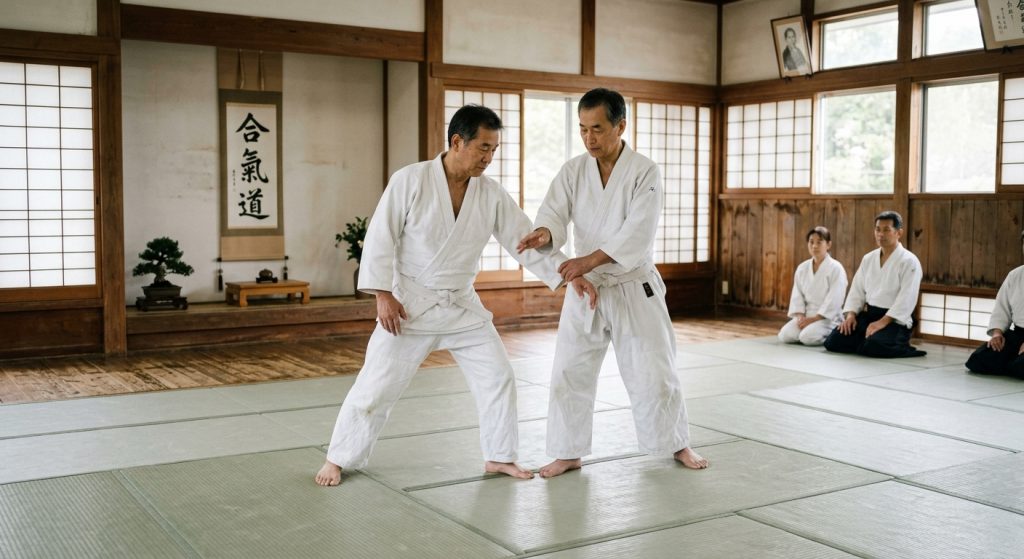
When people first encounter Aikido, its Japanese terminology, traditional uniforms, etiquette, and connection to the samurai arts can make it seem as though it must be hundreds of years old.
It isn’t.
Aikido is actually a relatively modern martial art.
Its founder, Morihei Ueshiba, was born in Japan in 1883. During his life he studied several traditional Japanese martial systems, including jujutsu, and eventually began developing an approach of his own. The name Aikido was formally adopted in 1942.
That makes Aikido younger than the automobile.
But Aikido’s relatively recent origin doesn’t mean it appeared from nowhere. Ueshiba’s training connected it to much older Japanese martial traditions. What changed was the question he was trying to answer.
Martial arts have historically dealt with a very practical problem:
How do I defeat an opponent?
Ueshiba increasingly became interested in another question:
Can martial skill resolve conflict without making destruction the goal?
That distinction helped shape Aikido.
Modern Aikido training still involves throws, joint controls, pins, movement, balance, timing, distance, weapons practice in some traditions, and the study of how one person physically interacts with another. It is unmistakably a martial art.
Yet victory over another person is not supposed to be its final objective.
Current Aikido Doshu Moriteru Ueshiba describes the founder’s shift as moving away from martial arts whose ultimate purpose was simply winning and toward the idea of harmony with others.
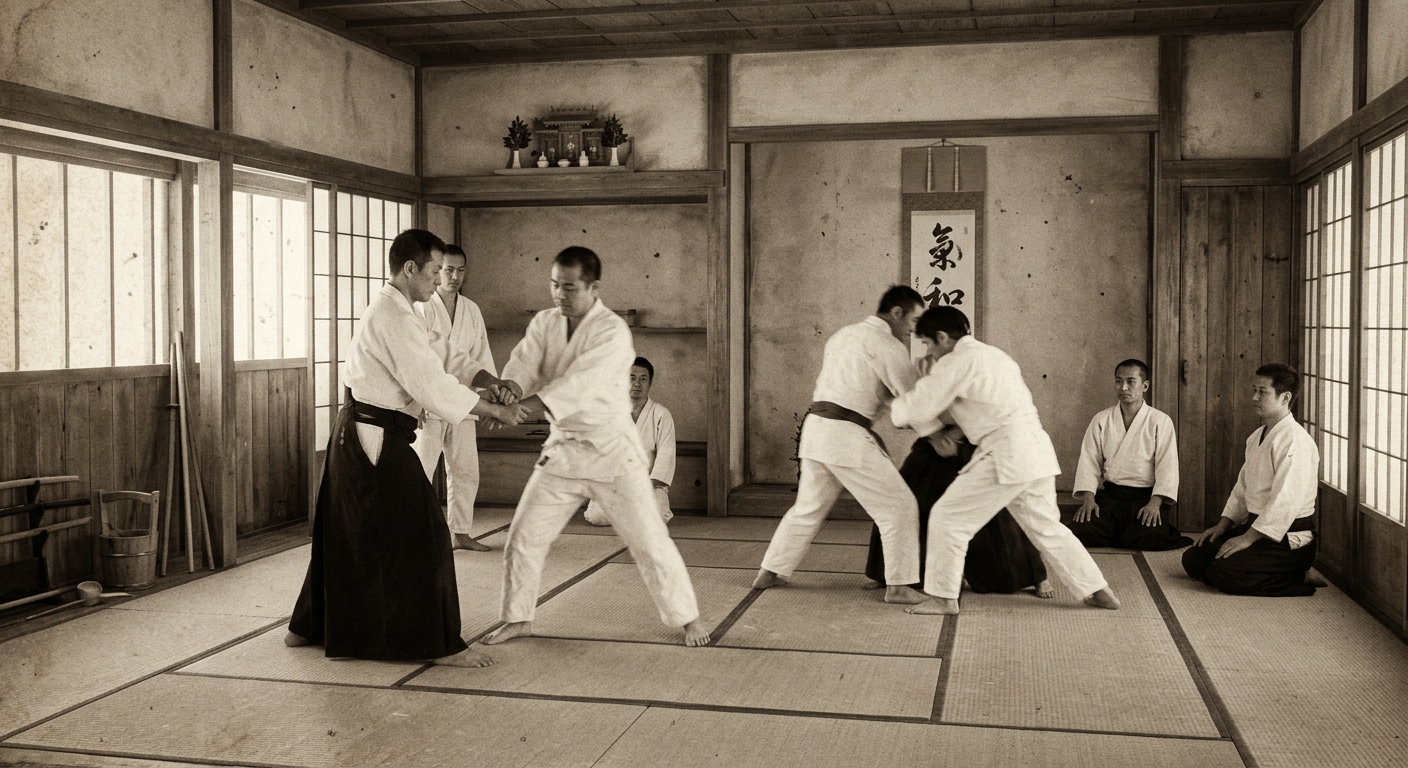 That creates an interesting challenge for the student.
It is relatively easy to practice cooperation when nothing is going wrong.
It is considerably harder when someone is pushing you, grabbing you, disrupting your balance, invading your space, or forcing you to react quickly.
That is where Aikido becomes more than an abstract philosophy.
The mat becomes a laboratory.
Can you remain relaxed while pressure increases?
Can you move instead of freezing?
Can you recognize what direction force is traveling?
Can you protect yourself without automatically responding with greater force?
Can you maintain awareness of both yourself and the other person?
Those are martial questions, but they are also human ones.
Perhaps that is one reason Aikido has spread so widely. The International Aikido Federation and Aikikai report that the art is now practiced in more than 140 countries and regions.
Aikido may not be ancient.
Instead, it is something arguably more interesting: a modern attempt to take lessons developed through centuries of martial practice and ask how they might be applied to the problem of conflict itself.
And nearly a century later, we are still exploring the answer.