
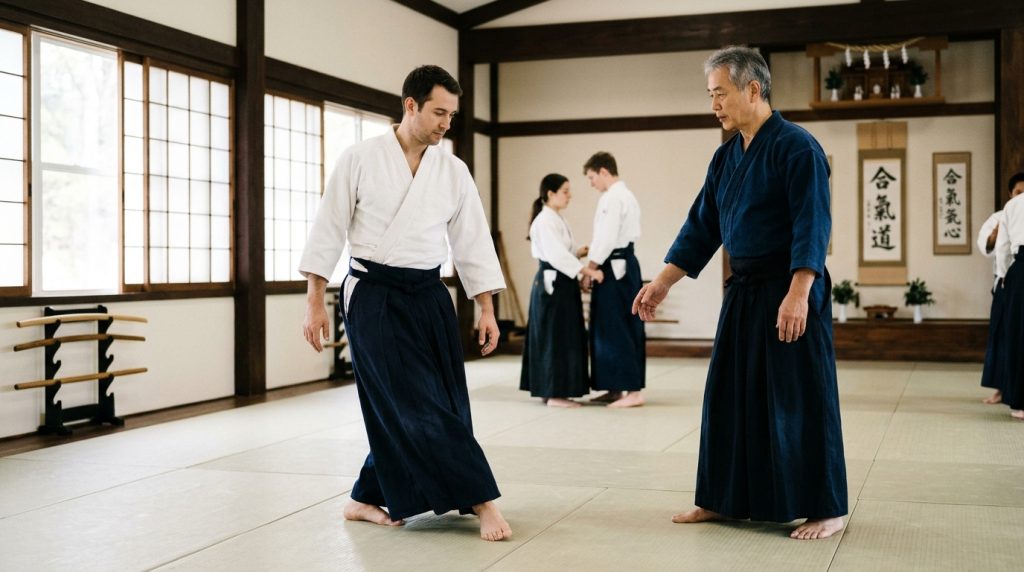
A partner reaches for your wrist.
A few months ago, you might have been so focused on remembering the technique that you barely noticed what they were doing. This time, you feel yourself leaning forward before your instructor says anything.
You reset your posture and try again.
Nobody applauds. There is no promotion. From across the room, the second attempt may not even look much different from the first.
But something changed.
You noticed.
That raises an interesting question in martial arts:
How do you know you’re getting better when progress doesn’t always announce itself?
The Value—and Limits—of a Milestone
Ranks and examinations serve a real purpose.
They give students specific material to prepare, provide instructors with opportunities to evaluate skills, and mark meaningful stages in training.
The Aikikai Hombu Dojo examination guidelines, for example, specify both minimum practice requirements and technical material for advancement through its grading system. Recognized Aikikai organizations may conduct their own kyu examinations, so exact requirements can vary outside Hombu.
Even official requirements count training days—and that matters. Time on the mat creates opportunities to learn.
But attendance tells us how much practice someone has accumulated, not everything they understood during that practice.
A test is therefore useful as a checkpoint without being a complete description of development.
Someone may perform a required sequence successfully while still struggling when the situation changes slightly.
Another student might make an obvious mistake yet recognize problems with distance, balance, or timing that they could not see a month earlier.
Both observations tell us something.
Sometimes Progress Begins With What You Notice
Early in training, a student may be occupied simply remembering where to put their feet.
With experience, their attention can shift.
They begin noticing that their weight is too far forward. Their shoulders tighten when they hurry. They have drifted too close to their partner.
Recognizing an error does not mean being able to correct it immediately.
But it can change the question from:
“Why can’t I do this?”
to:
“What, specifically, needs to change?”
That distinction matters.
It is closely related to what happens when a technique doesn’t work. A failed attempt becomes more useful when it gives us something to investigate.
Instead of adding more strength, perhaps we change the angle.
Instead of blaming our partner, perhaps we ask what they exposed in our movement.
The technique may still need work.
But the practice has become more informative.
A Difficult Class Is Not Necessarily a Bad Class
Some evenings everything feels easy.
A familiar partner moves in familiar ways. The instructor teaches material you know. Your technique feels smooth.
Then another class seems to expose every weakness you have.
Which class produced more learning?
We cannot know simply from how comfortable the practice felt.
Motor-learning researchers Guadagnoli and Lee proposed the Challenge Point Framework, which suggests that the usefulness of a practice challenge depends partly on the learner’s skill and the difficulty of the task.
That does not mean harder practice is automatically better. The framework comes largely from laboratory and sport-related motor-learning research, so applying it directly to partnered Aikido is an inference.
Still, it offers a useful question:
Was the task difficult because I was learning something just beyond what I can currently do—or was it simply inappropriate for my present ability?
Those are very different situations.
Practice that is unsafe, persistently confusing, or far beyond someone’s current ability needs adjustment.
But a class feeling awkward is not, by itself, evidence that you went backward.
Progress Includes the Person Others Train With
Improvement is not only visible in the person applying a technique.
Consider the role of uke.
Can you offer a clear and appropriate attack without trying to turn every repetition into a contest?
Can you remain aware of your own balance and safety?
Can you adjust your pace when working with someone less experienced without becoming completely passive?
Those can become practiced abilities too.
The same is true of caring for the dojo, noticing hazards, returning equipment properly, and helping a newer student understand how the training space works.
None of these produces a dramatic throw.
But they affect the quality of practice other people receive.
Progress sometimes means becoming a more capable person to train with.
Aikido Makes This Question Especially Interesting
Within Aikikai practice, there are no tournaments designed to determine who is better than whom. Other branches of Aikido, such as Shodokan, do include competitive formats, so this is not a universal statement about every form of Aikido.
But for many practitioners, there is no weekly score telling us whether we are improving.
That makes self-assessment more important—and sometimes more difficult.
Research on learning provides another useful caution here: looking better during practice is not always the same thing as producing lasting learning.
A smooth session can feel reassuring.
A difficult session can feel discouraging.
Neither feeling tells the whole story.
Keep One Small Record
One simple practice can make quieter progress easier to see.
At the end of class, identify one thing that changed.
Write it down if that helps.
Perhaps:
- I finally understood why I keep losing my balance during that entry.
- I noticed tension before my instructor pointed it out.
- I adjusted my pace better with a newer partner.
The observation does not need to be profound.
Over several months, those small notes can reveal changes that are easy to miss from one class to the next.
They also give us something more useful than asking whether today’s practice merely felt good.
What Matters Beyond the Test
Formal standards still matter.
Technique matters.
Consistent practice matters.
Examinations matter.
But none of them requires us to ignore the smaller evidence appearing between promotions.
We can become better at noticing.
Better at adjusting.
Better at understanding why something failed.
Better at giving another person useful practice.
Those changes do not replace rank.
They help explain what the time between ranks is actually for.
And sometimes the clearest sign that our training is developing is not that we can perform a more impressive technique.
It’s that we have become someone others can learn with.