
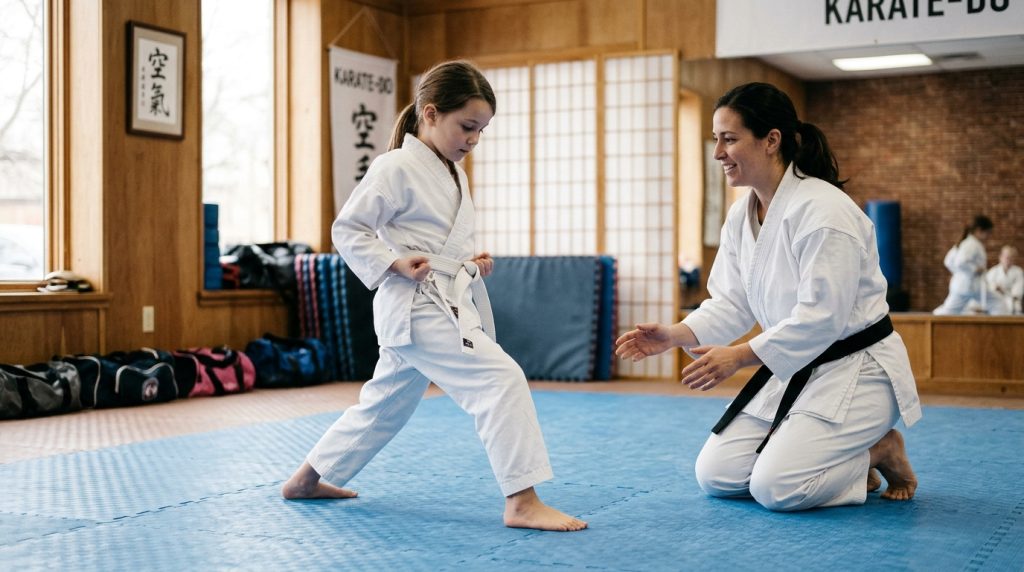
Watch a child trying to learn a new movement.
The instructor demonstrates a simple turn. The child attempts it, gets their feet tangled, loses their balance, and stops.
They look toward the instructor.
Perhaps they look toward a parent watching from the side.
Someone immediately wants to help.
That instinct makes sense. We see someone struggling, particularly a child, and naturally want to make things easier.
We explain the movement again. We demonstrate it. We physically guide them through the steps. Sometimes we offer the answer before they have even had a chance to think about the question.
And sometimes that is exactly what a child needs.
But sometimes it isn’t.
One of the more difficult skills adults can develop is recognizing when a child needs assistance—and when they simply need another opportunity to try.
A martial arts dojo provides an interesting environment in which to explore that distinction.
The Temptation to Make Things Easier
Adults are generally much better at being adults than children are.
That sounds obvious, but it creates an interesting problem when we’re teaching.
We already know how to tie the belt.
We understand the footwork.
We can remember the sequence.
We know what the completed movement is supposed to look like.
So when a child struggles, the solution seems obvious.
Just show them.
Just fix their feet.
Just move their arm into the correct position.
The problem is that completing a task for someone isn’t necessarily the same as helping them learn to complete it.
Consider the difference between guiding a student’s hand through a movement and helping them recognize why the movement wasn’t working.
Both approaches may have a place.
But they accomplish different things.
One produces an immediate result.
The other can create an opportunity for understanding.
And that distinction extends well beyond martial arts.
Not Every Struggle Is a Bad Thing
Learning something genuinely new often involves being temporarily unsuccessful.
A child learning to ride a bicycle doesn’t begin with perfect balance.
A young musician doesn’t play a piece correctly on the first attempt.
A student learning mathematics rarely understands every concept immediately.
Martial arts are no different.
But we should be careful here.
There is a popular idea that struggle automatically builds character.
It doesn’t.
A task that is far beyond a child’s current ability may produce little useful learning. Repeated frustration without guidance can become discouraging rather than productive.
The objective isn’t to make things unnecessarily difficult.
It’s to find a challenge the child can meaningfully work through.
The Harvard Center on the Developing Child describes a related concept called scaffolding: providing developmentally appropriate support, then gradually reducing that assistance as a person becomes more capable. Harvard Center on the Developing Child
This is a useful way to think about teaching martial arts.
We aren’t choosing between helping a child and leaving them alone.
We’re learning how much help is appropriate.
Give Them Something They Can Use
Imagine a student struggling with a basic turning movement.
An instructor could repeat the entire demonstration.
Or they might offer something smaller.
“Watch which foot moves first.”
The student tries again.
Perhaps the instructor asks, “What happened when you turned?”
The student considers the question.
Maybe they notice something.
Maybe they don’t.
Either way, the instructor now has information about what the student understands.
The next explanation can address that specific difficulty rather than repeating everything.
This is an important distinction between correction and useful feedback.
A systematic review published in 2021 examined 23 studies involving feedback during physical education. The researchers found strong evidence that feedback helps students learn motor skills compared with receiving no feedback, although the relative effectiveness of different feedback approaches was less consistent. PubMed
The practical lesson isn’t that instructors should talk less or always use questions.
It’s that feedback should serve the learning process.
Sometimes the best response is a demonstration.
Sometimes it’s a small correction.
Sometimes it’s breaking the movement into simpler components.
And sometimes it’s allowing another attempt before intervening.
The goal isn’t to provide as little help as possible. It’s to provide the help that makes the next useful attempt possible.
Progress Is More Interesting Than Perfection
Children often look to adults to determine whether they’ve succeeded.
Did I do it right?
Was that good?
Are you proud of me?
Those questions create an opportunity.
We can focus exclusively on whether the movement was correct.
Or we can help children recognize what changed.
“You remembered to move your feet this time.”
“You stopped when your partner asked.”
“You noticed something wasn’t working and tried a different approach.”
These observations recognize specific behaviors rather than simply offering approval.
They also give children information they can use.
The American Academy of Pediatrics encourages parents and coaches to emphasize enjoyment, learning, and progress in youth sports rather than concentrating primarily on winning or performance outcomes. Its guidance also stresses that activities should match a child’s developmental abilities. American Academy of Pediatrics
That doesn’t mean standards should disappear.
Correct technique matters.
Attention matters.
Effort matters.
But a child’s progress may be visible long before they can perform a movement consistently.
Recognizing that progress helps us avoid treating every class like an examination.
Knowing When to Intervene
There is an important limit to this discussion.
Martial arts involve physical contact, movement, and techniques that can cause injuries.
Children should never be expected to work through an unsafe situation simply because an adult believes struggle builds resilience.
A student attempting a movement beyond their physical ability needs appropriate support or a modified exercise.
A child experiencing pain needs the activity stopped and assessed.
A training partner who isn’t respecting boundaries requires immediate intervention.
And a student who is overwhelmed may need a break, a simpler task, or a different approach.
Allowing children to solve problems does not mean abandoning adult responsibility.
In fact, providing meaningful independence requires adults to remain attentive enough to know when guidance is necessary.
Different children will also need different levels and kinds of assistance. Age, experience, coordination, disability, confidence, and the particular activity all matter.
Good instruction adapts.
The objective is not to create an environment where children must prove how much difficulty they can tolerate.
It’s to create an environment where they can learn safely.
What Happens After Class?
Perhaps the most useful part of this discussion is that it doesn’t have to stay in the dojo.
Think about how frequently adults encounter the same decision.
A child struggles with homework.
They have difficulty assembling something.
They can’t figure out how to organize their belongings.
They have a disagreement with a friend.
Our first instinct may be to resolve the problem.
And sometimes we should.
But there may also be opportunities to ask a different question.
“What have you tried?”
“What do you think might work?”
“Would you like a little help getting started?”
These aren’t magic phrases.
They won’t work in every situation, and children don’t always have the experience or resources to solve a problem independently.
But they can create room for a child to participate in finding a solution.
That participation matters.
The Goal Is Capability
The purpose of youth martial arts isn’t simply to produce children who can perform techniques on command.
At least, it shouldn’t be.
We want students who can listen, move, think, cooperate, recognize limitations, and gradually take more responsibility for their own learning.
Those abilities don’t appear automatically because someone puts on a martial arts uniform.
They require opportunities to practice, capable instruction, appropriate expectations, and an environment where asking for help is acceptable.
Sometimes the most useful thing an instructor can do is demonstrate.
Sometimes it’s correct.
Sometimes it’s encourage.
And sometimes it’s to step back just enough for the student to discover that the next attempt belongs to them.
Because helping a child become capable doesn’t mean making every challenge disappear.
It means helping them develop the ability to meet challenges with an appropriate combination of effort, judgment, and support.