
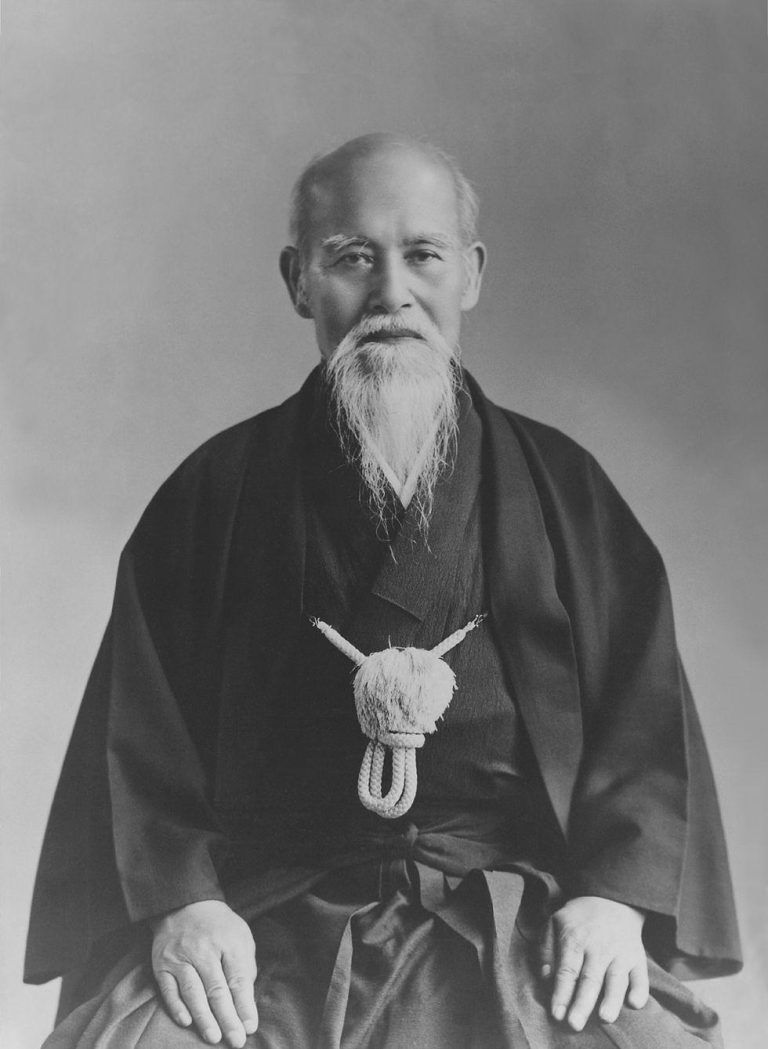
Who Was Morihei Ueshiba? The Man Behind Aikido
Martial arts sometimes feel as though they arrived fully formed.
There is a uniform. A set of techniques. Traditions. Etiquette. Terminology. A way of moving that students are told has been handed down from teacher to student.
But every martial art also has a history, and Aikido has something particularly useful: a founder whose life is recent enough to document.
Morihei Ueshiba was born in Tanabe, Japan, on December 14, 1883. Aikido practitioners commonly refer to him as O-Sensei, usually translated as “Great Teacher.” He died in 1969, meaning that Aikido’s development belongs much more to modern history than to some distant samurai age. Aikikai
That matters because understanding Ueshiba helps us understand something important about Aikido itself:
It was not invented in a single moment.
It evolved.
From Tanabe to Hokkaido
Ueshiba’s early life did not begin with a plan to create a new martial art.
He studied several martial traditions as a young man and, in 1912, led a group of settlers from his home region to Hokkaido, Japan’s northern island. It was there that one of the most important relationships in Aikido history began.
Around 1915, Ueshiba met Sokaku Takeda and began studying Daito-ryu, a sophisticated jujutsu tradition emphasizing joint control, balance disruption, throws, and methods of controlling an opponent’s structure.
The connection was substantial rather than casual. Records from the Daito-ryu tradition show that Ueshiba trained extensively with Takeda and later received authorization to teach on his behalf. Many of the technical ideas recognizable in Aikido can be traced through that relationship. Daito Ryu
This is worth remembering because martial arts history is sometimes made cleaner than reality.
A founder rarely begins with nothing.
Ueshiba inherited technical knowledge from teachers before him. What eventually became Aikido developed through what he did with that inheritance.
A Different Kind of Question
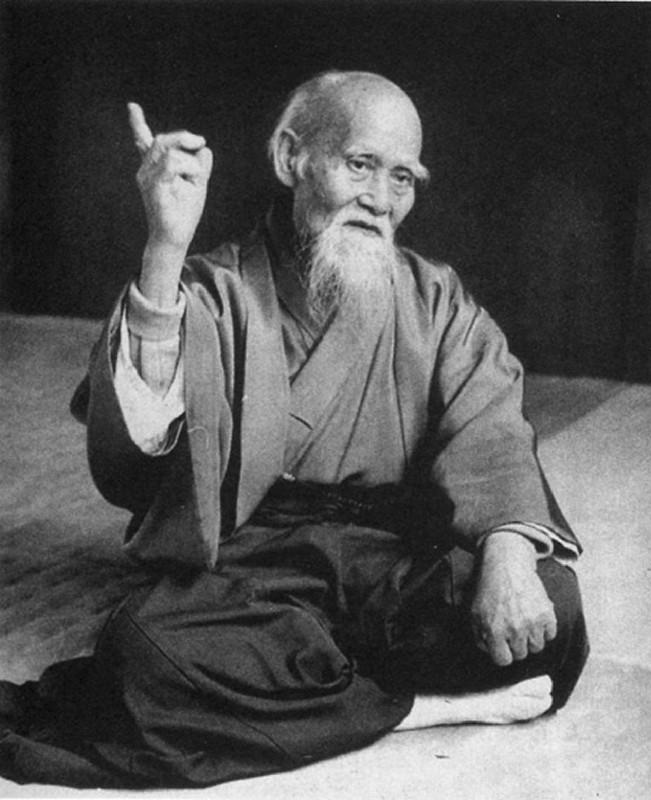 In 1919 Ueshiba left Hokkaido and eventually settled for a period in Ayabe, where he became closely associated with Onisaburo Deguchi and the Omoto religious movement.
According to the Aikikai’s official history, this became a period of intense spiritual study as well as martial practice. By 1920, Ueshiba had opened a training space known as the Ueshiba-juku. Aikikai
That combination of martial training and spiritual inquiry became increasingly important.
Ueshiba was not simply asking how a person could become more effective at defeating another person. His writings and later teaching increasingly dealt with harmony, self-development, reconciliation, and the purpose of martial practice itself.
Current Aikido Doshu Moriteru Ueshiba describes the founder’s development as a movement away from martial arts concerned primarily with winning through power and toward an art centered on harmony. Aikikai
That does not mean Ueshiba stopped being a martial artist.
It means the question changed.
Instead of only asking:
How do I overcome another person?
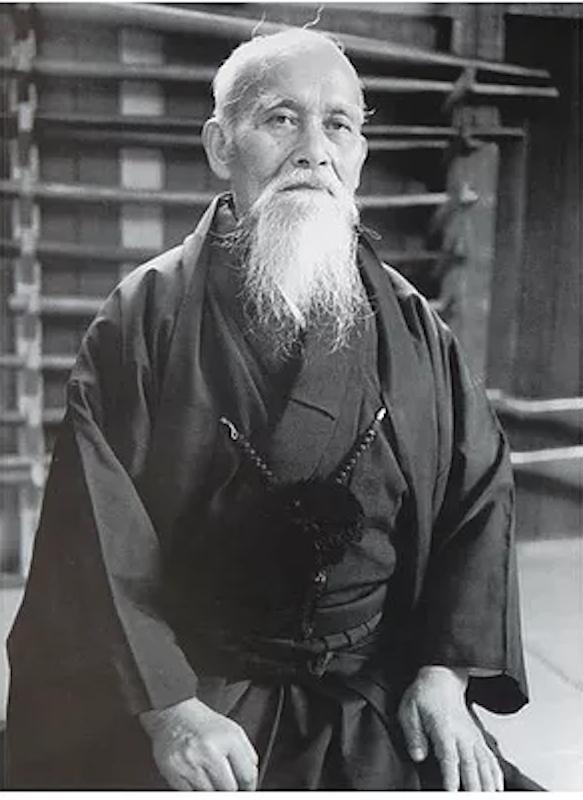 Aikido increasingly began asking:
What should martial power be for?
That question is still sitting underneath our practice today.
Aikido Wasn’t Created Overnight
Ueshiba moved his primary activities to Tokyo in 1927. In 1931, the Kobukan Dojo was established there.
But even then, the art was still developing.
The official name Aikido was not adopted until 1942. Around the same period, Ueshiba shifted much of his attention to Iwama in Ibaraki Prefecture, where the Aiki Shrine and what became the Ibaraki Dojo were established during the war years. After the war, the Aikikai Foundation was formally recognized in 1948. Aikikai
That timeline gives us an interesting way to think about a “founder.”
Ueshiba was not someone who designed a finished curriculum one afternoon and then spent the rest of his life repeating it.
His training changed.
His priorities changed.
His language changed.
His understanding of what martial arts were supposed to accomplish changed.
Aikido developed along with him.
The Founder Was Part of the Process
That can sometimes be uncomfortable in martial arts.
We like certainty.
We want to know the correct technique.
The correct interpretation.
The authentic version.
But Ueshiba’s own life suggests something more complicated.
He inherited ideas from older systems, practiced them intensely, questioned them, changed them, and continued exploring.
That does not mean history is irrelevant or that anything we invent can simply be called Aikido.
Quite the opposite.
Knowing where the art came from gives us something against which to examine what we are doing now.
But respecting a tradition does not necessarily require freezing it.
Ueshiba himself did not.
What Does That Mean for Us?
Most of us will never create a martial art.
That probably is not the useful lesson.
The useful lesson may be that serious practice involves both inheritance and investigation.
Someone teaches us a movement.
We practice it.
We discover where it succeeds.
We discover where it fails.
We learn the principle underneath it.
Our understanding becomes more sophisticated.
Then, eventually, we help someone else understand it.
That process is visible throughout Morihei Ueshiba’s life.
He was the founder of Aikido.
But perhaps more importantly for those of us practicing today, he was also a student who kept asking what his training meant.
Aikido did not emerge because he stopped questioning.
It emerged because he continued.
And more than half a century after his death, the people standing on mats around the world are still participating in that same conversation.
“Learn more about Aikido at The MAT Center”