
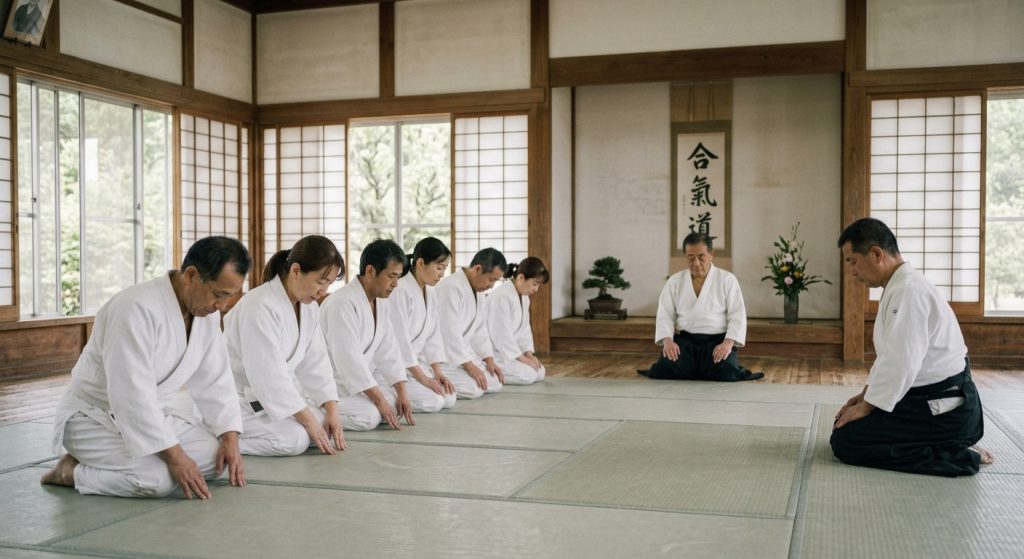
Walk into almost any traditional Japanese martial arts dojo and you will see people bowing.
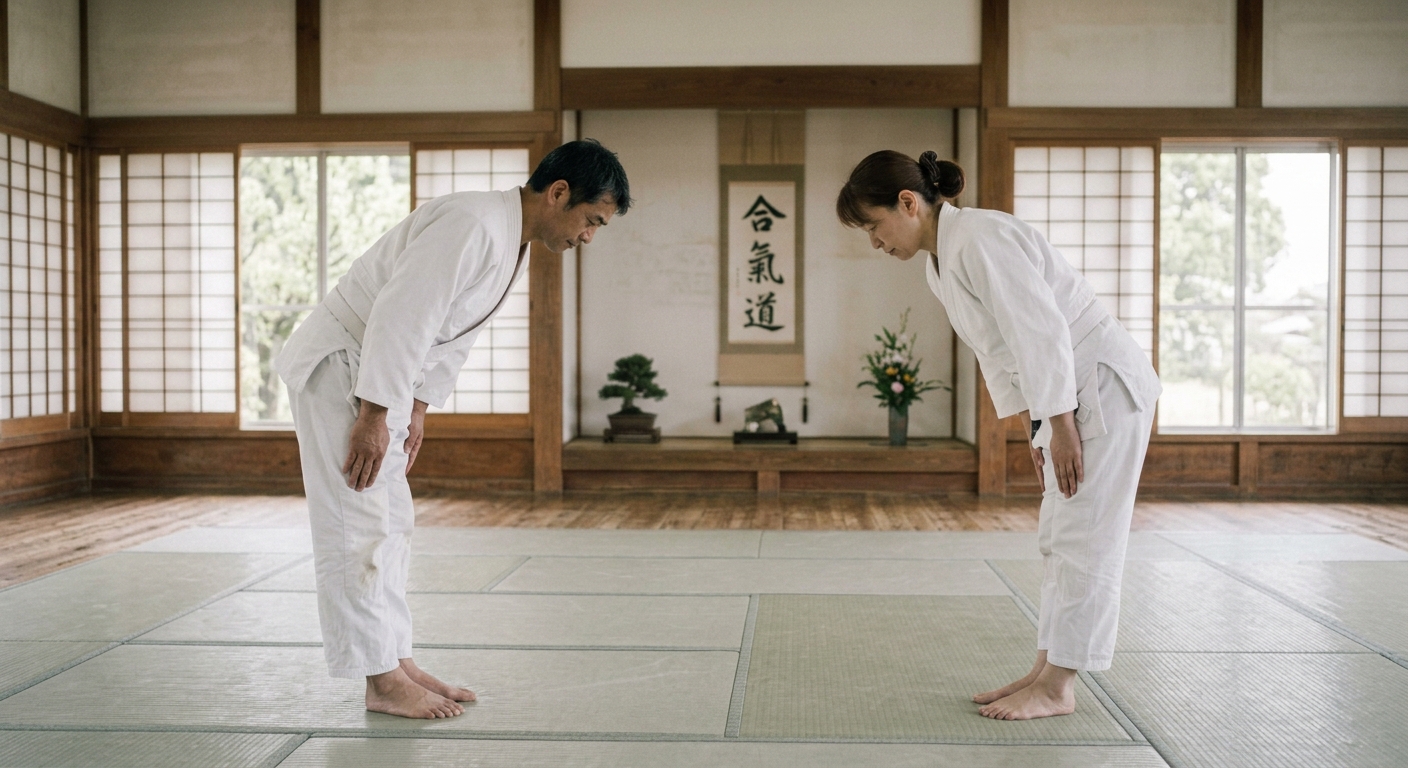
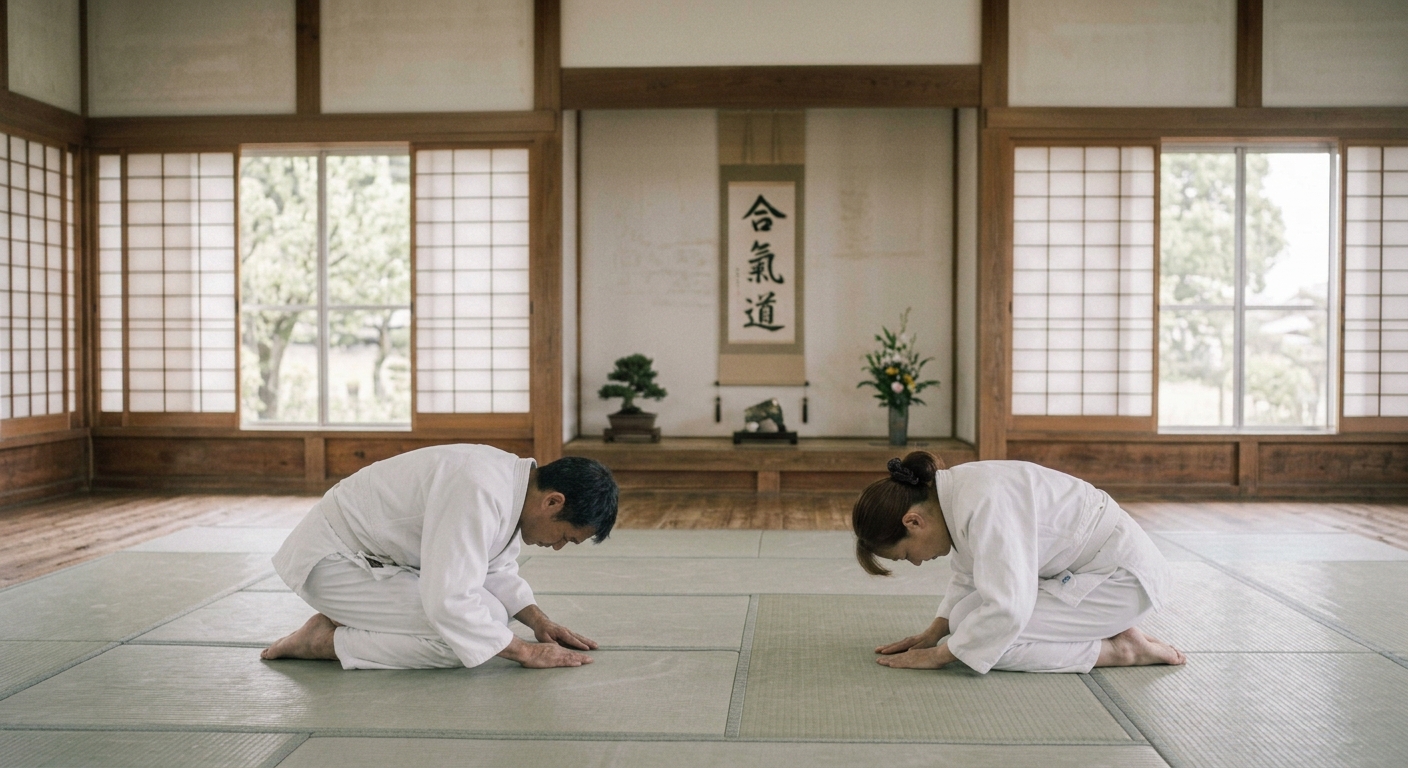
Students may bow when entering the training space. They bow at the beginning and end of class. They may bow to an instructor, to a training partner, or before and after practicing a technique.
For someone new to martial arts, this can seem unusually formal.
Why all the bowing?
The simplest answer is respect.
But that answer is incomplete.
A bow in the dojo is not necessarily an act of submission, worship, or agreement. It is better understood as a physical expression of courtesy and acknowledgment.
In Japanese martial culture, etiquette is not separate from training. It is part of the training.
The Japanese Budō Association, which includes Aikikai among its member organizations, describes respect and courtesy as fundamental parts of budō practice. Its Budō Charter specifically says practitioners should act with respect and courtesy during training, and describes the dojo as a special place where proper courtesies and discipline should be maintained.
There is even a traditional expression often associated with Japanese martial arts:
Rei ni hajimari, rei ni owaru.
Budō begins with courtesy and ends with courtesy.
That sounds philosophical, but it has a very practical purpose.
We Are Practicing Dangerous Things Together
Martial arts training creates an unusual relationship.
Your partner may grab you, strike toward you, throw you, pin you, apply a joint control, or place you in a position where you could potentially be injured.
And then you switch roles.
That only works when both people agree—implicitly and explicitly—to take care of one another.
A bow can serve as a small acknowledgment of that relationship.
We are about to practice together.
I will take my role seriously.
I will challenge you appropriately.
I will also help protect you.
When the practice ends, another bow closes that exchange.
Even after a difficult round or a frustrating technique, we recognize that our partner helped make the training possible.
That changes the nature of the interaction.
Your partner is not simply an obstacle.
They are part of your education.
Courtesy Is Easy Until You Don’t Feel Like Being Courteous
 Etiquette also gives martial artists a chance to practice something more difficult than memorizing customs.
It asks us to control our behavior.
It is easy to be respectful when we are comfortable.
It is harder when we are tired.
Or frustrated.
Or when someone keeps correcting us.
Or when a partner is moving differently than we want them to.
Or when we believe we are more experienced than the person standing in front of us.
This is where etiquette becomes meaningful.
Anyone can behave politely when everything is going their way.
Training asks whether we can maintain composure and respect when things become inconvenient.
That is an entirely different skill.
The Bow Creates a Boundary
 There is another useful way to think about bowing.
It creates a transition.
Before training begins, you may have been thinking about work, traffic, school, dinner, an argument, or something you need to do tomorrow.
Then you enter the dojo.
The bow can become a small mental marker:
I am here now.
At the end of class, the process reverses.
You acknowledge the training space, your instructors, and the people who helped you practice, then return to ordinary life.
Nothing mystical has to occur.
It is simply an intentional change of attention.
Modern life gives us remarkably few transitions like this. We move from meetings to text messages to dinner to television while carrying one activity mentally into the next.
The dojo asks us to be present.
The etiquette helps.
Respect Does Not Mean Rank Has Unlimited Authority
There is an important distinction worth making.
Respect for dojo etiquette should never mean abandoning judgment.
A martial arts instructor should not become unquestionable simply because someone bows to them.
A senior student is still capable of being wrong.
Tradition should not override safety.
Courtesy and critical thinking can coexist.
In fact, they should.
The Japanese Budō Charter places responsibilities on teachers as well as students. It says instructors should continue developing their own understanding, help students improve themselves, and serve as role models.
Respect in a healthy dojo therefore moves in more than one direction.
Students respect instructors.
Instructors respect students.
Training partners respect each other.
Everyone respects the practice.
Eventually, the Bow Should Mean Something
When someone first begins martial arts, bowing may simply be another instruction.
Stand here.
Put your feet this way.
Bow.
After a while, though, the movement can become connected to something deeper.
Gratitude.
Attention.
Humility.
Responsibility.
Recognition of the person standing across from you.
Perhaps that is why such a small gesture has remained so visible in Japanese martial arts.
The bow itself takes only a second.
What it represents may take a lifetime to practice.