
Someone makes a comment.
You know exactly what they are doing.
Maybe it is a coworker trying to provoke you.
A stranger in traffic.
A family member bringing up the same argument again.
A social media post practically designed to make people angry.
You feel the reaction almost immediately.
Your attention narrows.
Your body changes.
You begin constructing the response in your head.
And suddenly someone else has decided what you are going to do next.
They offered the bait.
You took it.
One of the more interesting lessons martial arts can offer has very little to do with fighting.
It is the ability to recognize pressure without automatically responding in the way that pressure seems to demand.
An Attack Contains an Invitation
 Imagine someone pushes you.
The most instinctive response may be to push back.
They pull.
You resist.
They become tense.
You become tense.
Force meets force.
In martial arts, however, that is not always the most useful response.
Sometimes the better choice is to move.
To change the angle.
To allow force to travel farther than expected.
To create space.
To redirect rather than collide.
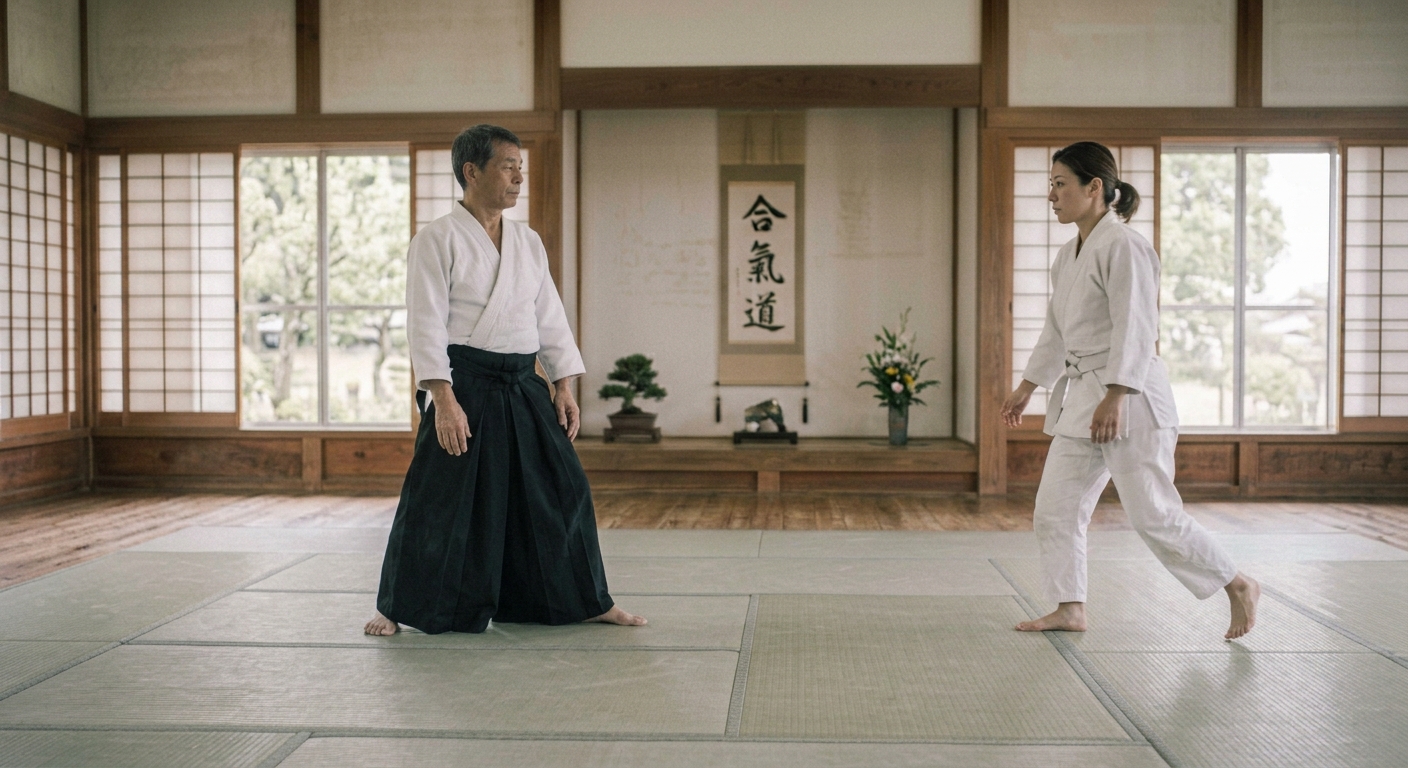
Aikido spends considerable time exploring this idea physically.
But the principle becomes interesting when we notice how often the same pattern appears away from the mat.
Someone becomes louder.
We become louder.
Someone becomes insulting.
We search for a better insult.
Someone becomes defensive.
We begin preparing our prosecution.
We often allow another person’s behavior to determine our own.
Not Reacting Is Not the Same as Doing Nothing
This is where an important distinction appears.
Refusing to take the bait does not mean becoming passive.
It does not mean allowing people to mistreat you.
It does not mean avoiding difficult conversations.
And it certainly does not mean pretending that conflict does not exist.
Sometimes the correct response is firm.
Sometimes you need to say no.
Sometimes a boundary needs to be established.
Sometimes you need to leave.
Sometimes you need to confront a problem directly.
The question is not whether we respond.
The question is:
Who is choosing the response?
If someone can reliably make us angry, defensive, reckless, or cruel simply by applying the right pressure, then our behavior is not entirely under our control.
That is uncomfortable to admit.
It is also useful.
The First Victory May Be Over Your Own Momentum
When practicing a martial technique, one of the hardest habits to overcome is the urge to force an expected outcome.
We decide what should happen.
Then reality does something different.
Our partner moves.
Our angle changes.
The technique begins to fail.
So we try harder.
More muscle.
More speed.
More determination.
Sometimes the real problem is that we have become committed to an answer that no longer fits the situation.
Everyday arguments can work the same way.
We enter a conversation trying to win.
Then we stop listening.
We are no longer asking, “What is happening here?”
We are asking, “How do I get this person to admit that I am right?”
Those are very different questions.
The ability to interrupt that momentum can change the entire interaction.
Create Space Before You Decide
Martial arts frequently deals with distance.
Too close, and you may not have time to react.
Too far away, and you may not be able to act effectively.
The appropriate distance gives you options.
We can create psychological distance too.
A breath before answering.
A moment before sending the text.
Walking away from the computer.
Asking a question instead of immediately making an accusation.
Saying, “I want to think about that before I respond.”
These are small actions.
But small spaces create choices.
And choice is where self-control begins.
You Don’t Have to Attend Every Fight You’re Invited To
One of the strange things about conflict is how often participation feels mandatory.
Someone criticizes us, so we must answer.
Someone misunderstands us, so we must correct them.
Someone posts something ridiculous, so apparently the internet requires our immediate intervention.
But not every provocation deserves a response.
Sometimes the most skillful action is refusing the invitation entirely.
This can feel unsatisfying because ego likes closure.
We want the last word.
We want the other person to understand.
We want witnesses to know who was right.
Yet winning an argument and improving a situation are not always the same thing.
That distinction is worth remembering.
Calm Is a Capability
People sometimes mistake calmness for temperament.
“He’s just a calm person.”
Perhaps.
But calmness can also be practiced.
Every time we recognize an emotional reaction without immediately obeying it, we are practicing.
Every time we choose an appropriate response instead of the most satisfying one, we are practicing.
Every time training becomes frustrating and we reset rather than explode, we are practicing.
That does not mean becoming emotionless.
The goal is not to eliminate anger, fear, frustration, or pride.
Those emotions contain information.
The challenge is preventing them from becoming automatic instructions.
Martial arts teaches us to pay attention to forces acting upon the body.
With enough reflection, we may begin noticing the forces acting upon the mind as well.
And occasionally, the most important technique we practice is recognizing the bait—
and deciding not to bite.