
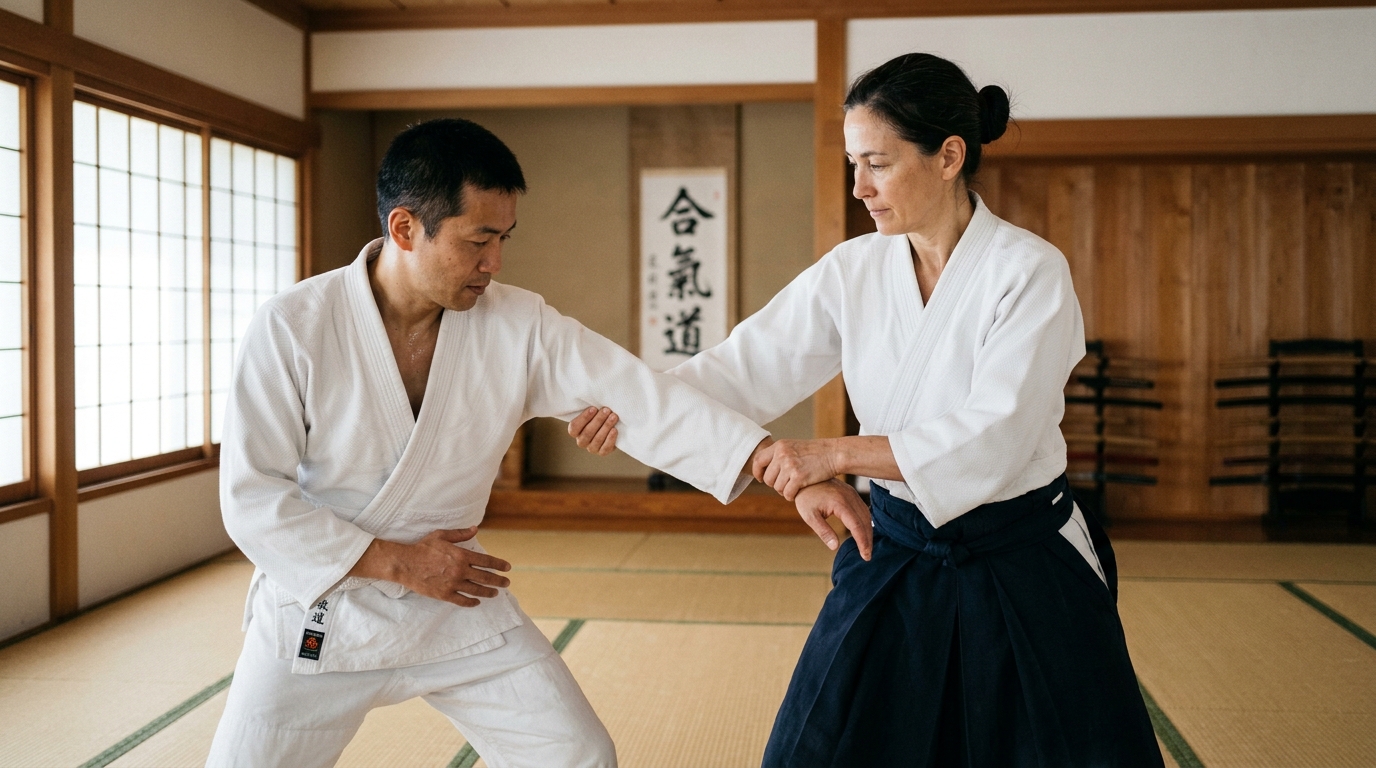
Watch an Aikido demonstration, and it is easy to focus on the person performing the technique.
They move off the line of attack. They turn. They redirect their partner’s balance. Someone falls.
Naturally, our attention follows the person who appears to be in control.
But there is another person participating in that exchange.
The one who attacked.
The one whose balance was disrupted.
The one who eventually found themselves on the mat.
And that person may be doing just as much learning.
In Aikido, we often spend considerable time discussing how to execute techniques. We examine footwork, timing, posture, connection, and the subtle mechanics of balance.
But what about the other half of the interaction?
What are we supposed to be learning when we are the person receiving the technique?
The answer goes considerably deeper than learning how to fall.
A Role, Not a Ranking
In traditional Aikido practice, partners alternate between two roles.
The person applying the technique is commonly called tori or nage, depending on the terminology used. The person receiving the technique is called uke.
The process of receiving is known as ukemi.
The Aikikai, Aikido’s principal international organization, specifically describes training as a cooperative exchange in which practitioners take turns performing these roles.
Neither role is secondary. Both contribute to the learning process. Aikikai
This is an important distinction.
Uke is not simply the person whose job is to lose.
Nor is uke a training dummy whose responsibility ends after providing an attack.
Being uke requires awareness, sensitivity, movement, judgment, and responsibility.
In some respects, these skills can be harder to develop than the mechanics of applying a particular technique.
After all, when you are nage, you generally know what you are trying to accomplish.
When you are uke, you must learn to understand what is happening to you.
An Honest Attack Is Part of the Lesson
Consider something as simple as a wrist grab.
If uke barely holds the wrist, there may be little meaningful connection for nage to study.
If uke uses every available ounce of strength to prevent movement, a beginner may never have the opportunity to understand the technique being introduced.
Neither extreme necessarily serves the lesson.
The purpose of the attack matters.
Sometimes we are examining a particular movement.
Sometimes we are studying balance.
Sometimes we are investigating how a change in grip, direction, timing, or resistance affects the outcome.
A thoughtful uke should understand what the exercise is intended to teach.
That does not mean making everything easy.
It means providing an appropriate challenge.
There is a significant difference between cooperating with the learning process and pretending a technique worked when it did not.
Cooperation Is Not the Same as Compliance
This distinction deserves attention because it addresses one of the more legitimate criticisms of cooperative martial arts training.
If a person throws themselves simply because they recognize a familiar movement, what exactly has been demonstrated?
Perhaps very little about the effectiveness of the technique.
But cooperation itself is not the problem.
Structured practice is how we isolate and develop skills.
A musician practices scales.
An athlete repeats specific movements.
A martial artist studies techniques under controlled conditions.
The challenge is remembering what those conditions are designed to accomplish.
A useful uke provides feedback without turning every repetition into a competition.
They do not collapse before their balance has actually been affected.
They do not deliberately sabotage a beginner’s attempt to understand a movement.
And they do not confuse stubborn resistance with realism.
As training progresses, the challenge can change.
The resistance becomes more varied.
The attacks become less predictable.
The movement becomes less scripted.
Good ukemi is not about helping someone look effective. It is about helping both people understand what is actually happening.
additional reading: when a technique doesn’t work…
Ukemi Begins Before the Fall
When people hear the word ukemi, they often think immediately of forward rolls, backward rolls, and breakfalls.
Those are important skills.
But receiving a technique begins long before someone reaches the ground.
It begins with awareness.
Where is your balance?
What direction is your partner moving?
Are you maintaining your posture?
Can you move your feet?
Are you recognizing a change in pressure before it becomes a problem?
And perhaps most importantly, are you paying attention to what your partner is actually doing rather than what you expected them to do?
Experienced practitioners sometimes make receiving techniques look effortless.
They appear to move almost simultaneously with their partners.
But that appearance should not be mistaken for passivity.
They are responding to information.
That is an important part of the art.
Safety Is a Shared Responsibility
There is another reason to take ukemi seriously.
We are practicing techniques that can injure people.
Joint controls, throws, changes in balance, and unexpected movement all introduce physical risk.
Research into serious Aikido training accidents has emphasized the importance of recognizing the hazards inherent even in structured practice. J-STAGE
Learning to receive techniques appropriately is therefore an essential part of developing as a practitioner.
But that responsibility belongs to both partners.
Nage must consider the experience, limitations, and safety of uke.
Uke must remain attentive, communicate discomfort, and recognize when a movement exceeds their ability to receive it safely.
A beginner should not be expected to take the same falls as someone with decades of experience.
An experienced practitioner should not have to demonstrate toughness by ignoring pain.
And no one should feel obligated to continue an unsafe movement simply because a more senior practitioner expects it.
Trust, however, should be supported by judgment—not used as a substitute for it.
The Person Being Thrown Is Also Studying the Technique
There is something especially interesting about learning from the receiving side.
When applying a technique, our attention can become consumed by what we are trying to accomplish.
We concentrate on our hands.
Our feet.
Our posture.
The sequence we remember from the demonstration.
But when receiving the technique, we experience its effects directly.
We feel when our balance changes.
We notice when pressure disappears.
We recognize when our partner’s structure is effective—and when it is not.
Over time, these experiences can help develop a more complete understanding of the movement.
The person applying the technique studies how to create an effect.
The person receiving it studies how that effect occurs.
Both perspectives matter.
And because Aikido partners continually exchange roles, we have an opportunity to examine the same interaction from both sides.
That is an unusually valuable learning arrangement.
Take Both Roles Seriously
The next time you practice, consider giving your time as uke the same deliberate attention you give your time as nage.
Not simply because you want to become better at falling.
And not because you want to make your partner’s techniques look impressive.
Instead, approach the receiving role as another opportunity to investigate the principles of the art.
Pay attention to connection.
Notice when your balance changes.
Recognize how your partner’s movement affects your own.
Provide honest, appropriate feedback.
Take responsibility for your safety and that of the person practicing with you.
Because Aikido is not something one person does while another person waits for their turn.
It is something two people study together.
And sometimes, the most valuable lesson comes when we are not the person doing the throwing.