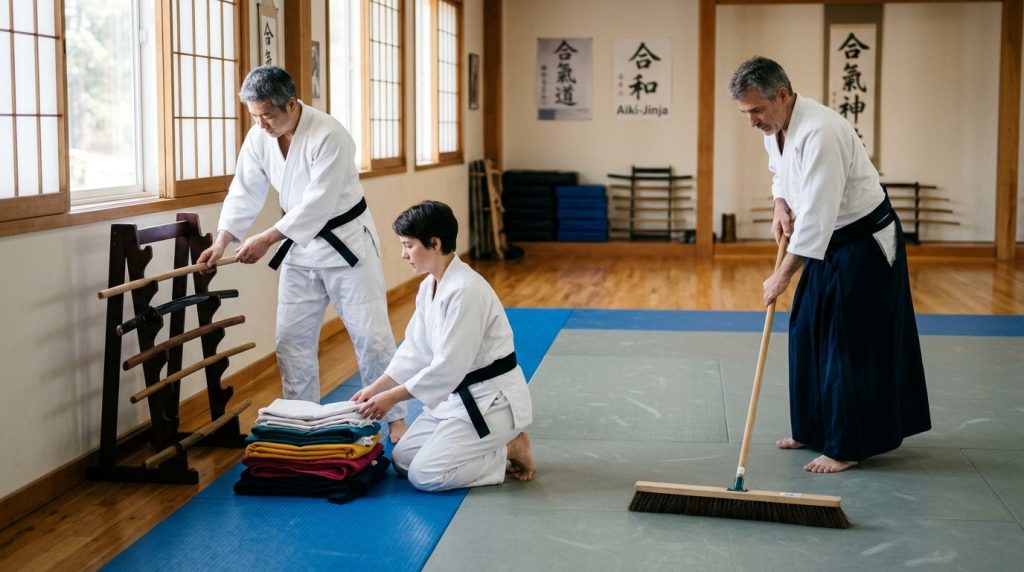
An empty dojo can tell you quite a lot about the people who train there.
The mats are ready. Training equipment is in its place. There is room to move. Nothing has been left behind for the next class to deal with.
Most visitors won’t notice those details.
They notice when something is wrong.
A loose mat. A forgotten water bottle. Equipment blocking a walkway.
A martial arts school may spend an hour teaching balance, attention, and responsibility. But what happens before and after that hour can reveal whether those ideas have become everyday habits.
The question isn’t simply who cleans the dojo.
It’s who understands that the space belongs to everyone who uses it.
A Place to Practice, Not Just a Place to Show Up
In Japanese martial arts, the dojo is traditionally treated as more than a room with mats.
The Japanese Budō Association’s Budō Charter, established in 1987, describes the dojo as a place for training the mind and body. It emphasizes maintaining a clean, safe environment and showing respect for the training space.
Its companion charter for young practitioners similarly places cleanliness and safety alongside courtesy and cooperation.
These aren’t complicated ideas. They also aren’t limited to Japan.
Anyone who has shared a workshop, classroom, community center, or kitchen knows the difference between using a space and taking responsibility for it.
The distinction becomes particularly clear in martial arts because our activities depend on the environment.
A clean, unobstructed mat is not a decorative preference.
It helps make safe movement and close-contact practice possible.
Cleanliness Has a Practical Purpose
Aikido training involves shared training surfaces, close contact, and frequent transitions between standing, kneeling, and the ground.
That makes cleanliness a practical consideration, not merely a traditional one.
The Centers for Disease Control and Prevention warns that skin infections, including those caused by MRSA, can spread in athletic settings through direct contact and contaminated shared surfaces.
Its guidance encourages good personal hygiene, prompt attention to suspected skin infections, and routine cleaning of shared equipment.
For a dojo, responsible habits include arriving with a clean uniform, keeping fingernails and toenails trimmed, addressing minor cuts appropriately, and telling an instructor about an injury or possible infection rather than ignoring it.
Facilities also need appropriate cleaning and maintenance procedures.
The method matters. Cleaning products should be suitable for the mat material, used according to their labels, and allowed to dry as directed.
None of this means a dojo can promise to eliminate infection risk.
It means we should take the risks we can reasonably manage seriously.
There Is More to Stewardship Than a Mop
Taking care of the dojo also means noticing what needs attention.
A training weapon left where someone may trip over it.
A mat edge beginning to separate.
A spill near the entrance.
A new student who doesn’t know where to place their shoes.
A visitor who seems unsure where to go.
Not every situation requires the same response. Some are simple things a student can correct. Others need to be reported to an instructor, particularly when repairs or safety concerns are involved.
The common thread is awareness.
During class, we’re asked to notice where our training partners are, how much space we have, and whether someone is moving into danger.
Caring for the room involves a similar willingness to pay attention.
It’s easy to overlook a problem when you assume someone else will handle it.
The harder habit is recognizing that you have a part to play.
Responsibility Should Not Depend on Rank
Some Aikido schools incorporate communal cleaning, often called sōji, into dojo life.
The practice varies.
In some places, students help after every class. Elsewhere, instructors or staff manage much of the facility work.
There is no need to pretend every school follows one universal custom.
More importantly, shared responsibility should not become an excuse to assign undesirable work only to beginners while experienced students stand aside.
An instructor who puts equipment away sets an example.
A senior student who helps a newcomer understand expectations makes the space easier to enter.
And a student who notices a problem and reports it appropriately contributes whether or not they know how to fix it.
This is not about turning martial arts students into unpaid maintenance workers.
Facility owners and instructors remain responsible for safe conditions, proper supplies, repairs, and supervision.
It is about understanding that membership in a learning community involves consideration for others.
Teaching Children the Difference
In youth martial arts, even small responsibilities can provide practical opportunities to participate in caring for a shared space.
A young student might help line up practice equipment, return a training pad to its place, or check that personal belongings are collected.
An adult should still decide what is age-appropriate and safe.
Children should not be assigned hazardous cleaners, asked to handle bodily fluids, or expected to repair damaged equipment.
And the goal shouldn’t be perfect obedience to an endless list of chores.
It should be learning to notice, contribute, and ask when help is needed.
This raises a familiar teaching question about when to step in and when to step back.
Just as with a new movement, the amount of assistance should fit the student and the task.
A child who cannot complete a responsibility independently may still be able to participate meaningfully with appropriate guidance.
What We Leave for the Next Person
There’s a quiet symmetry to dojo practice.
We enter a space prepared, at least in part, by the efforts of people who came before us.
We train with partners whose attention and willingness make our learning possible.
Then we leave.
What happens in that last moment matters.
Are the mats and tools ready for the next group?
Did we leave an avoidable problem behind?
Did someone new feel welcomed?
Those questions won’t appear on a belt test.
They aren’t proof of martial skill, either.
But they say something meaningful about how we approach a shared responsibility.
Bowing may acknowledge respect.
Taking care of the place where others practice is one way to make that respect visible.
The work isn’t glamorous.
That’s part of why it’s worth noticing.