
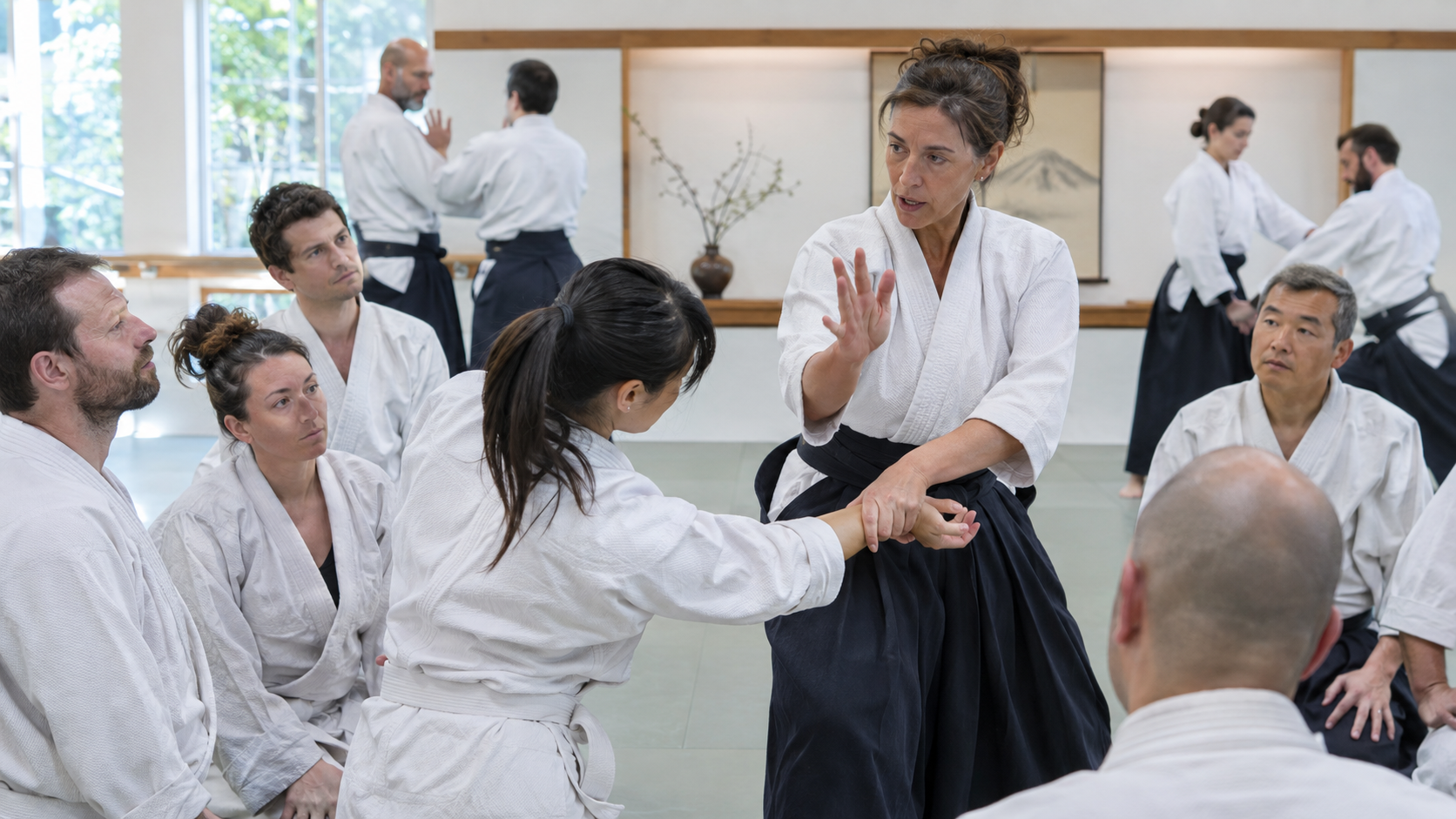
Imagine arriving at a seminar and hearing an instructor explain a movement you have practiced for years. You recognize the technique, step into position, and expect to know what comes next.
Then the instructor asks you to change something small: where your weight settles, when you turn, or how much connection you maintain with your partner.
Suddenly, a familiar technique feels unfamiliar.
That moment can be frustrating, especially for someone who has trained long enough to feel competent. It can also reveal one of the best reasons to attend a seminar: not to collect more techniques, but to examine what you think you already understand.
Familiar Practice Has Real Value
Regular training provides continuity. An instructor learns how you move, notices recurring habits, and can return to the same principle across months or years. Your training partners become familiar with your pace and abilities. That trust is valuable, particularly when practicing throws, falls, and joint controls.
Familiarity can also make certain things harder to notice.
You know how your regular partner usually attacks. They know which movements you are learning. Sometimes a technique works partly because both people have learned the rhythm of practicing it together.
There is nothing inherently wrong with that. Cooperative repetition helps us study a movement safely. The question is whether we can recognize which parts of an exchange belong to the technique and which depend on the particular person across from us.
A visiting instructor or unfamiliar partner changes some of those conditions.
It gives us a different view of the same practice.
Different Does Not Automatically Mean Better
An instructor may emphasize posture where your usual teacher emphasizes timing. One may begin with a large movement to make a principle visible; another may ask for a smaller movement that exposes the same problem.
It is tempting to respond by choosing sides.
We may decide that the new version is better, or that the version we already know must be correct.
Neither conclusion is necessary.
Different explanations can illuminate different features of a technique. They can also reflect genuine differences in method or teaching priorities. Sometimes instructions really are incompatible.
The productive response is to first understand the task being taught, rather than immediately trying to reconcile every variation.
That requires a temporary willingness to be a beginner again—even when you are not one.
A useful question is not, “Which instructor is right?” but “What is this instructor asking me to investigate?”
Your Partner Is Part of the Lesson
At a seminar, unfamiliar partners may have different reaches, speeds, balance, experience, or comfort with falling.
Those differences can affect an exercise without making anyone a better or worse martial artist.
They also remind us that uke—the person receiving the technique—is learning and making decisions, not simply taking a fall.
A good partner offers an attack appropriate to the exercise, pays attention, and gives the other person a real opportunity to study what is happening.
When training with someone new, agree on a workable pace and remain attentive to safety.
A person who falls comfortably in one way may not be ready for the same movement at the speed you usually practice. If something feels unsafe, say so, adjust, or ask the instructor for guidance.
Seminars are opportunities to train with new people, not invitations to test strangers or prove that a technique works.
The Skill of Being Teachable
A beginner may feel free to ask a simple question. An experienced student sometimes finds that harder.
There can be a quiet pressure to look as though you already understand.
You may nod at a correction, repeat the familiar version, and leave without having tried what the instructor actually showed.
Try the opposite.
Watch carefully, choose one detail, and make a sincere attempt at it. If it still does not make sense, ask a specific question at an appropriate moment.
“Are you changing the distance before the turn?” is often more useful than “Why do you do it differently?”
Courtesy also matters when visiting another dojo. Follow the host’s directions for entering the mat, partnering, and observing demonstrations.
If local customs differ from your home dojo, ask rather than assume.
Respectful attention does not require you to set aside your judgment, especially about injury or personal limits.
The goal is not to leave convinced of every explanation.
It is to leave having understood at least one of them better.
Take Something Home That You Can Actually Use
A weekend can contain far more information than one person can retain.
Trying to reproduce every detail afterward can turn an interesting experience into a collection of half-remembered movements.
Instead, look for one question worth bringing back to regular practice.
Perhaps you noticed that your posture changes when your partner is taller. Perhaps a different explanation made an old correction finally understandable. Perhaps you learned that you need to communicate your limits more clearly.
Write down the observation while it is fresh.
Share it with your regular instructor as a question or an experience, not as a declaration that the dojo should change its teaching.
Then test whether that understanding holds up over time.
The real value of visiting another mat is what happens when you return to your own.
An Invitation to Practice Together
That is the idea behind welcoming instructors and practitioners from beyond our usual training circle.
Aikido Shimbokukai has explicitly described cross-organizational seminars as a way to build relationships and cooperation among practitioners.
The point is not that everyone must practice identically, but that learning can continue across those differences.
The MAT Center and Kogyo Aikido will host Lisa Tomoleoni Shihan in Spring, Texas, on December 18–19, 2026.
The weekend is open to all skill levels and affiliations, with open-hand Aikido instruction and no weapons required.
Details and registration are available on our December seminar page.
Whether you attend this event or another seminar in the future, a useful goal is simple: arrive ready to notice something your ordinary practice has made easy to overlook.
You do not need to abandon what you have learned.
You only need to be willing to look at it again.